As I am a big fan of journalism especially what the Economist I thought it would be fun to do a bit of data journalism and try to publish it on my university news paper. So I was looking into the demographics of the University of Strathclyde the following is a short report on the changes
Over the years the University of Strathclyde has been through a lot of challenges, Brexit, Covid and strikes may have impacted the demographic and capacity of Strathclyde but in the following report will look at the data to discover trends
Gender
In a recent book called ‘Of Boys and Men: Why the Modern Male Is Struggling, Why It Matters, and What to Do About It’, published in 2022 is a book by British author Richard Reeves. Which this correspondent read, it talked about how the modern male is getting left behind education and this seems to as the University of Strathclyde became more female dominated with a trend seeming not to slow down.
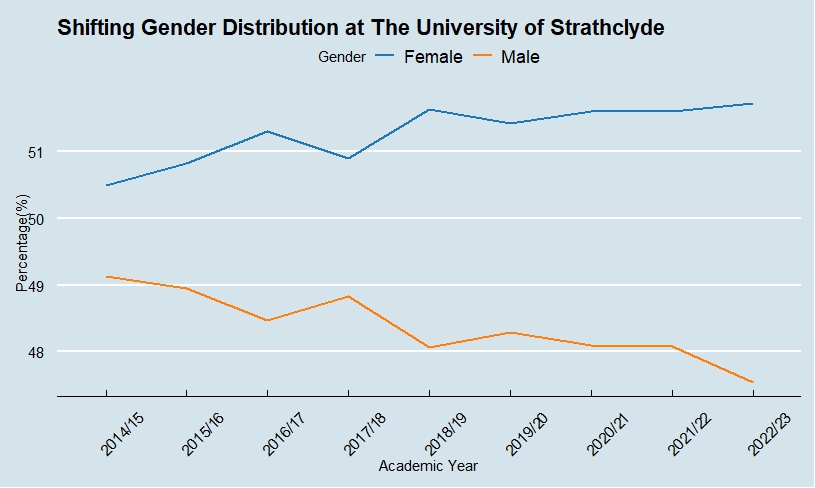
Now the gender gap doubled in size from around 51% female to 49% male, to around 53% female and 47%. But when the data is filtered for full time students a different trend is seen that is now around the 50% 50% mark which one would expect.
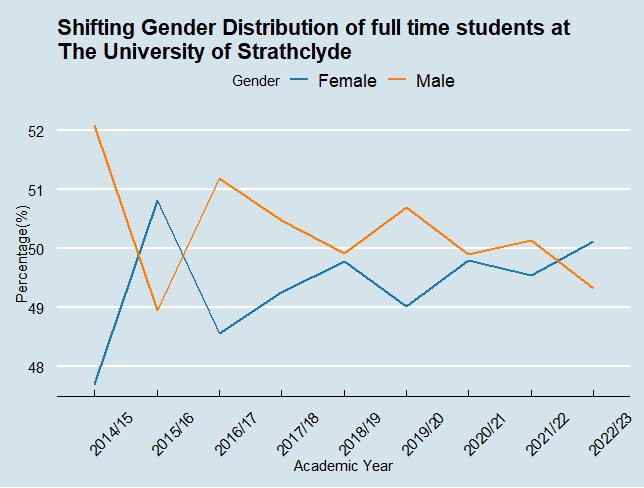
This can be explained as most part time students are female. The reasons of why can only be speculated but looking at full time students the University of Strathclyde is a well-balanced University which is desirable to many students.
Permanent Address
The capacity of the University of Strathclyde has expanded with 21,210 students in 2014/15 to 24,860 in 2022/23 which is the most recent data is correspondent could get. That is more than 17% increase in 8 years, showing the rising demand in higher education. What that number doesn’t show is where these extra students are from.
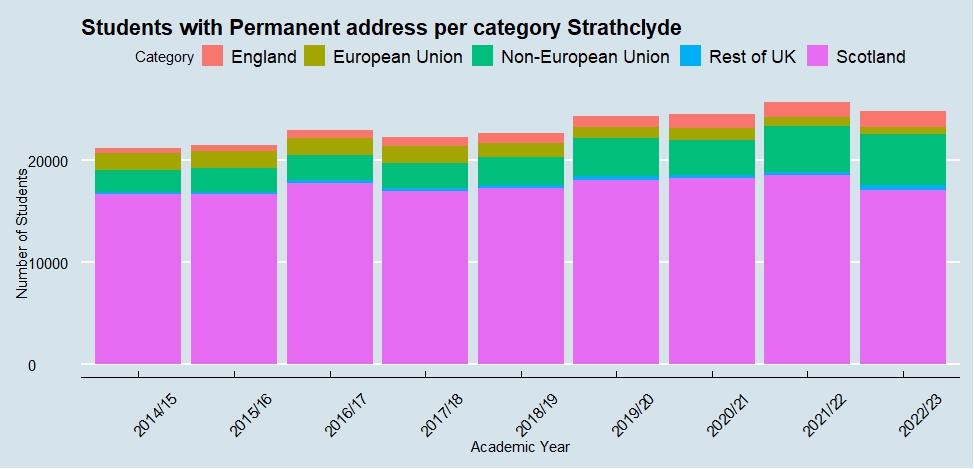
Looking at non-Scottish students there can be seen a general trend of a rise in Students from outside of Scotland. This trend is significant to the University as Scottish students get the first degree for free or pay £1,920 per year, compared to the rest of the UK that pays £9,250 per year, with international fees ranging from £19,850-£29,350 for the academic year of 2025/26
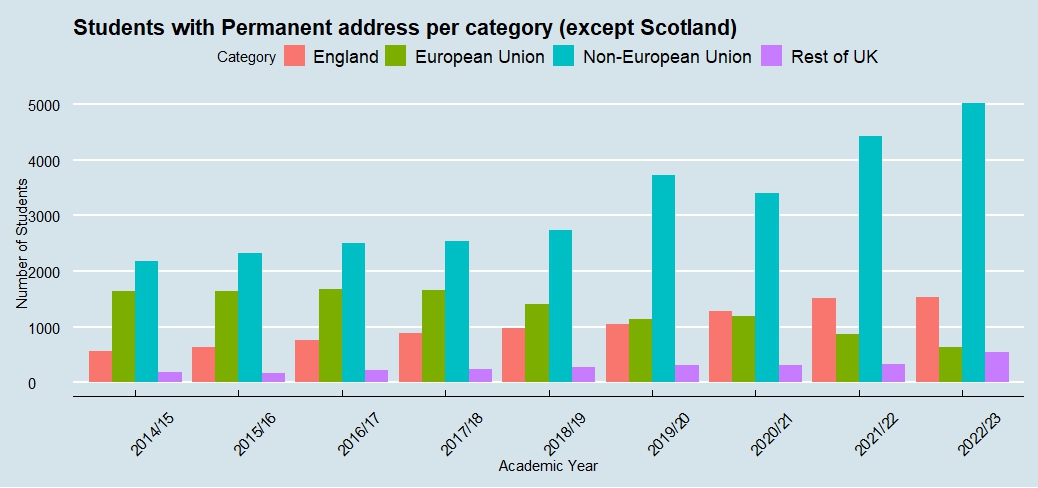
Over the 8 years the rise of non-Scottish students can be seen as the University campus has more students with a permanent address from abroad. With the only exception to this trend being the EU likely due to a consequence of Brexit. With the international Student population doubling in a staggering 8 years. This allows for universities to charge a higher price to international students covering the cost but with this economic incentive there will be less space for Scottish students who pay the lowest fee and in which the university gets the least amount of money.
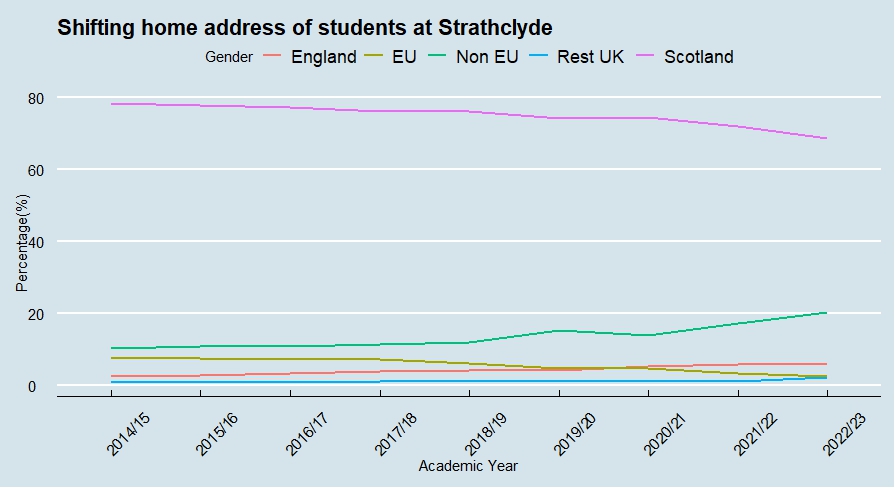
This can be seen as Scottish student are on the decline while non-EU students make over 20% of the population in 2022/23 from around 10% in 2014/15. While Scottish Students only make around 70% an absolute 10% decrease from 2014/15. More diversity and the extra resources the university gets from foreign should be welcome, but this cost might leave less space for the Scottish students. With the number of Scottish students being is lowest since 2014/15 in 2022/23 even though the university added more spaces, but it seems less spaces for Scottish students.
Link: https://www.hesa.ac.uk/data-and-analysis/students
Below you can see the code, there are many ways it could be more efficient and if I would rewrite it I would create a function to deal with all repetitiveness of reloading the code
Code:
#Strath students demographic

#Library
library(readr) # reading csv
library(dplyr) #select package
library(ggplot2)
library(tidyr)
library(ggthemes)
setwd("C:\\Users\\example")# change this to the address of the data

#Sorting out the data
{
#2022-2023
{
strath_2022_2023 <- read_csv("table-1-(2022-23).csv", skip=14)
strath_2022_2023_filtered <- strath_2022_2023 %>%
  filter(`HE provider` == "The University of Strathclyde")
students2022_2023 <-  strath_2022_2023_filtered %>%
  filter(`Country of HE provider` == "All") %>%
  filter(`Region of HE provider` == "All") %>%
  filter(`Entrant marker` == "All") %>%
  filter(`Level of study` == "All") %>%
  filter(`Mode of study` == "All")

students2022_2023 <- students2022_2023 %>% select(-(c(`Country of HE provider`,`Region of HE provider`,`Entrant marker`,`Level of study`,`Mode of study`)))
}
#2021-2022
{
  strath_2021_2022 <- read_csv("table-1-(2021-22).csv", skip=14)
  strath_2021_2022_filtered <- strath_2021_2022 %>%
    filter(`HE provider` == "The University of Strathclyde")
  students2021_2022 <-  strath_2021_2022_filtered %>%
    filter(`Country of HE provider` == "All") %>%
    filter(`Region of HE provider` == "All") %>%
    filter(`Entrant marker` == "All") %>%
    filter(`Level of study` == "All") %>%
    filter(`Mode of study` == "All")

  students2021_2022 <- students2021_2022 %>% select(-(c(`Country of HE provider`,`Region of HE provider`,`Entrant marker`,`Level of study`,`Mode of study`)))
}
#2020-2021
{
  strath_2020_2021 <- read_csv("table-1-(2020-21).csv", skip=14)
  strath_2020_2021_filtered <- strath_2020_2021 %>%
    filter(`HE provider` == "The University of Strathclyde")
  students2020_2021 <-  strath_2020_2021_filtered %>%
    filter(`Country of HE provider` == "All") %>%
    filter(`Region of HE provider` == "All") %>%
    filter(`Entrant marker` == "All") %>%
    filter(`Level of study` == "All") %>%
    filter(`Mode of study` == "All")

  students2020_2021 <- students2020_2021 %>% select(-(c(`Country of HE provider`,`Region of HE provider`,`Entrant marker`,`Level of study`,`Mode of study`)))
}
#2019-2020
{
  strath_2019_2020 <- read_csv("table-1-(2019-20).csv", skip=14)
  strath_2019_2020_filtered <- strath_2019_2020 %>%
    filter(`HE provider` == "The University of Strathclyde")
  students2019_2020 <-  strath_2019_2020_filtered %>%
    filter(`Country of HE provider` == "All") %>%
    filter(`Region of HE provider` == "All") %>%
    filter(`Entrant marker` == "All") %>%
    filter(`Level of study` == "All") %>%
    filter(`Mode of study` == "All")

  students2019_2020 <- students2019_2020 %>% select(-(c(`Country of HE provider`,`Region of HE provider`,`Entrant marker`,`Level of study`,`Mode of study`)))
}
#2018-2019
{
  strath_2018_2019 <- read_csv("table-1-(2018-19).csv", skip=14)
  strath_2018_2019_filtered <- strath_2018_2019 %>%
    filter(`HE provider` == "The University of Strathclyde")
  students2018_2019 <-  strath_2018_2019_filtered %>%
    filter(`Country of HE provider` == "All") %>%
    filter(`Region of HE provider` == "All") %>%
    filter(`Entrant marker` == "All") %>%
    filter(`Level of study` == "All") %>%
    filter(`Mode of study` == "All")

  students2018_2019 <- students2018_2019 %>% select(-(c(`Country of HE provider`,`Region of HE provider`,`Entrant marker`,`Level of study`,`Mode of study`)))
}
#2017-2018
{
  strath_2017_2018 <- read_csv("table-1-(2017-18).csv", skip=14)
  strath_2017_2018_filtered <- strath_2017_2018 %>%
    filter(`HE provider` == "The University of Strathclyde")
  students2017_2018 <-  strath_2017_2018_filtered %>%
    filter(`Country of HE provider` == "All") %>%
    filter(`Region of HE provider` == "All") %>%
    filter(`Entrant marker` == "All") %>%
    filter(`Level of study` == "All") %>%
    filter(`Mode of study` == "All")

  students2017_2018 <- students2017_2018 %>% select(-(c(`Country of HE provider`,`Region of HE provider`,`Entrant marker`,`Level of study`,`Mode of study`)))
}
#2016-2017
{
  strath_2016_2017 <- read_csv("table-1-(2016-17).csv", skip=14)
  strath_2016_2017_filtered <- strath_2016_2017 %>%
    filter(`HE provider` == "The University of Strathclyde")
  students2016_2017 <-  strath_2016_2017_filtered %>%
    filter(`Country of HE provider` == "All") %>%
    filter(`Region of HE provider` == "All") %>%
    filter(`Entrant marker` == "All") %>%
    filter(`Level of study` == "All") %>%
    filter(`Mode of study` == "All")

  students2016_2017 <- students2016_2017 %>% select(-(c(`Country of HE provider`,`Region of HE provider`,`Entrant marker`,`Level of study`,`Mode of study`)))
}
#2015-2016
{
  strath_2015_2016 <- read_csv("table-1-(2015-16).csv", skip=14)
  strath_2015_2016_filtered <- strath_2015_2016 %>%
    filter(`HE provider` == "The University of Strathclyde")
  students2015_2016 <-  strath_2015_2016_filtered %>%
    filter(`Country of HE provider` == "All") %>%
    filter(`Region of HE provider` == "All") %>%
    filter(`Entrant marker` == "All") %>%
    filter(`Level of study` == "All") %>%
    filter(`Mode of study` == "All")

  students2015_2016 <- students2015_2016 %>% select(-(c(`Country of HE provider`,`Region of HE provider`,`Entrant marker`,`Level of study`,`Mode of study`)))
}
#2014-2015
{
  strath_2014_2015 <- read_csv("table-1-(2014-15).csv", skip=14)
  strath_2014_2015_filtered <- strath_2014_2015 %>%
    filter(`HE provider` == "The University of Strathclyde")
  students2014_2015 <-  strath_2014_2015_filtered %>%
    filter(`Country of HE provider` == "All") %>%
    filter(`Region of HE provider` == "All") %>%
    filter(`Entrant marker` == "All") %>%
    filter(`Level of study` == "All") %>%
    filter(`Mode of study` == "All")

  students2014_2015 <- students2014_2015 %>% select(-(c(`Country of HE provider`,`Region of HE provider`,`Entrant marker`,`Level of study`,`Mode of study`)))
}

#main is the origin of all merged df
{
main_dt <- full_join(students2022_2023, students2021_2022)
main_dt <- full_join(main_dt, students2020_2021)
main_dt <- full_join(main_dt, students2019_2020)
main_dt <- full_join(main_dt, students2018_2019)
main_dt <- full_join(main_dt, students2017_2018)
main_dt <- full_join(main_dt, students2016_2017)
main_dt <- full_join(main_dt, students2015_2016)
main_dt <- full_join(main_dt, students2014_2015)
}
}
# Gender related all students
{
gender_data <- main_dt %>%
  filter(`Category marker` == "Sex") %>%
  #filter(`Mode of study` == "All") %>%
  select(`Academic Year`, Category, Number) %>%
  spread(key = Category, value = Number)

# Calculate percentages
gender_data <- gender_data %>%
  mutate(Total = Female + Male + Unknown,
         Female_Percent = (Female / Total) * 100,
         Male_Percent = (Male / Total) * 100,
         Unknown_Percent = (Unknown / Total) * 100)


#gender_data <- sort_by.data.frame(gender_data, gender_data$`Academic Year`, decreasing = TRUE)
# Gender distribution over time
ggplot(gender_data, aes(x = `Academic Year`, group = 1), size = 1) +
  geom_line(aes(y = Female_Percent, color = "Female"),size = 1) +
  geom_line(aes(y = Male_Percent, color = "Male"),size = 1) +
  #geom_line(aes(y = Unknown_Percent,x = `Academic Year`, color = "Unknown"), size = 1) +
  scale_color_manual(values = c("Female" = "#1f77b4", "Male" = "#ff7f0e", "Unknown" = "#2ca02c")) +
  labs(title = "Shifting Gender Distribution at The University of Strathclyde",
       x = "Academic Year", y = "Percentage(%)",
       color = "Gender") +
  theme_economist() +
  theme(axis.text.x = element_text(angle = 45, hjust = 0))
}
#Residence stuff
{

#cleaning and grouping the data

  df_clean <- residence_data %>%
    filter(!Category %in% c("Total", "Total Non-UK", "Total UK"))

  df_with_sum <- df_clean %>%
    # Filter rows for 'Other UK', 'Wales', and 'Northern Ireland'
    filter(Category %in% c("Other UK", "Wales", "Northern Ireland")) %>%
    # Group by academic year and sum these categories
    group_by(`Academic Year`) %>%
    summarise(Number = sum(Number)) %>%
    mutate(Category = "Rest of UK") %>%
    ungroup()


  df_final_percent <- bind_rows(df_clean, df_with_sum) %>%
    # Filter out specific categories as needed
    filter(!Category %in% c("Other UK", "Wales", "Northern Ireland", "Not known")) %>%
    # Calculate the total number of students per year
    group_by(`Academic Year`) %>%
    mutate(Total_Year = sum(Number)) %>%
    # Calculate the percentage of each category for the year
    mutate(Percentage = (Number / Total_Year) * 100) %>%
    ungroup()

  # Combine the two dataframes together
  df_final <- bind_rows(df_clean, df_with_sum)  %>%
    filter(!Category %in% c("Other UK", "Wales", "Northern Ireland", "Not known", "Scotland"))


  ggplot(df_final_percent, aes(x = `Academic Year`, y = Number, fill = Category)) +
    geom_bar(stat = "identity") +
    labs(
      title = "Students with Permanent address per category Strathclyde",
      x = "Academic Year",
      y = "Number of Students",
      fill = "Category"
    ) +
    theme_economist() +
    theme(axis.text.x = element_text(angle = 45, hjust = 0))

  ggplot(df_final, aes(x = `Academic Year`, y = Number, fill = Category)) +
    geom_bar(stat = "identity",position = "dodge") +
    labs(
      title = "Non-Scottish permemant address for Strathclyde",
      x = "Academic Year",
      y = "Number of Students",
      fill = "Category"
    ) +
  theme_economist() +
    theme(axis.text.x = element_text(angle = 45, hjust = 0))


  #looking at perdentage changes

  category_percentage <- df_final_percent %>%

    select(`Academic Year`, Category, Number) %>%
    spread(key = Category, value = Number)

  # Calculate percentages
  category_percentage <- category_percentage %>%
    mutate(Total = England + `European Union` + `Non-European Union`+ `Rest of UK` + Scotland,
           England_Percent = (England / Total) * 100,
           EU_Percent = (`European Union` / Total) * 100,
           Non_EU_Percent = (`Non-European Union` / Total) * 100,
           Rest_UK_Percent = (`Rest of UK` / Total) * 100,
           Scotland_Percent = (Scotland / Total) * 100)

  ggplot(category_percentage, aes(x = `Academic Year`, group = 1), size = 1) +
    geom_line(aes(y = England_Percent, color = "England"),size = 1) +
    geom_line(aes(y = EU_Percent, color = "EU"),size = 1) +
    geom_line(aes(y = Non_EU_Percent, color = "Non EU"),size = 1) +
    geom_line(aes(y = Rest_UK_Percent, color = "Rest UK"),size = 1) +
    geom_line(aes(y = Scotland_Percent, color = "Scotland"),size = 1) +
    #geom_line(aes(y = Unknown_Percent,x = `Academic Year`, color = "Unknown"), size = 1) +
    #scale_color_manual(values = c("Female" = "#1f77b4", "Male" = "#ff7f0e", "Unknown" = "#2ca02c")) +
    labs(title = "Shifting home address of students at Strathclyde",
         x = "Academic Year", y = "Percentage(%)",
         color = "Gender") +
    theme_economist() +
    theme(axis.text.x = element_text(angle = 45, hjust = 0))
}


#Sorting out the data this time to do full time students
{
  #2022-2023
  {
    strath_2022_2023 <- read_csv("table-1-(2022-23).csv", skip=14)
    strath_2022_2023_filtered <- strath_2022_2023 %>%
      filter(`HE provider` == "The University of Strathclyde")
    students2022_2023 <-  strath_2022_2023_filtered %>%
      filter(`Country of HE provider` == "All") %>%
      filter(`Region of HE provider` == "All") %>%
      filter(`Entrant marker` == "All") %>%
      filter(`Level of study` == "All") %>%
      filter(`Mode of study` == "Full-time")

    students2022_2023 <- students2022_2023 %>% select(-(c(`Country of HE provider`,`Region of HE provider`,`Entrant marker`,`Level of study`,`Mode of study`)))
  }
  #2021-2022
  {
    strath_2021_2022 <- read_csv("table-1-(2021-22).csv", skip=14)
    strath_2021_2022_filtered <- strath_2021_2022 %>%
      filter(`HE provider` == "The University of Strathclyde")
    students2021_2022 <-  strath_2021_2022_filtered %>%
      filter(`Country of HE provider` == "All") %>%
      filter(`Region of HE provider` == "All") %>%
      filter(`Entrant marker` == "All") %>%
      filter(`Level of study` == "All") %>%
      filter(`Mode of study` == "Full-time")

    students2021_2022 <- students2021_2022 %>% select(-(c(`Country of HE provider`,`Region of HE provider`,`Entrant marker`,`Level of study`,`Mode of study`)))
  }
  #2020-2021
  {
    strath_2020_2021 <- read_csv("table-1-(2020-21).csv", skip=14)
    strath_2020_2021_filtered <- strath_2020_2021 %>%
      filter(`HE provider` == "The University of Strathclyde")
    students2020_2021 <-  strath_2020_2021_filtered %>%
      filter(`Country of HE provider` == "All") %>%
      filter(`Region of HE provider` == "All") %>%
      filter(`Entrant marker` == "All") %>%
      filter(`Level of study` == "All") %>%
      filter(`Mode of study` == "Full-time")

    students2020_2021 <- students2020_2021 %>% select(-(c(`Country of HE provider`,`Region of HE provider`,`Entrant marker`,`Level of study`,`Mode of study`)))
  }
  #2019-2020
  {
    strath_2019_2020 <- read_csv("table-1-(2019-20).csv", skip=14)
    strath_2019_2020_filtered <- strath_2019_2020 %>%
      filter(`HE provider` == "The University of Strathclyde")
    students2019_2020 <-  strath_2019_2020_filtered %>%
      filter(`Country of HE provider` == "All") %>%
      filter(`Region of HE provider` == "All") %>%
      filter(`Entrant marker` == "All") %>%
      filter(`Level of study` == "All") %>%
      filter(`Mode of study` == "Full-time")

    students2019_2020 <- students2019_2020 %>% select(-(c(`Country of HE provider`,`Region of HE provider`,`Entrant marker`,`Level of study`,`Mode of study`)))
  }
  #2018-2019
  {
    strath_2018_2019 <- read_csv("table-1-(2018-19).csv", skip=14)
    strath_2018_2019_filtered <- strath_2018_2019 %>%
      filter(`HE provider` == "The University of Strathclyde")
    students2018_2019 <-  strath_2018_2019_filtered %>%
      filter(`Country of HE provider` == "All") %>%
      filter(`Region of HE provider` == "All") %>%
      filter(`Entrant marker` == "All") %>%
      filter(`Level of study` == "All") %>%
      filter(`Mode of study` == "Full-time")

    students2018_2019 <- students2018_2019 %>% select(-(c(`Country of HE provider`,`Region of HE provider`,`Entrant marker`,`Level of study`,`Mode of study`)))
  }
  #2017-2018
  {
    strath_2017_2018 <- read_csv("table-1-(2017-18).csv", skip=14)
    strath_2017_2018_filtered <- strath_2017_2018 %>%
      filter(`HE provider` == "The University of Strathclyde")
    students2017_2018 <-  strath_2017_2018_filtered %>%
      filter(`Country of HE provider` == "All") %>%
      filter(`Region of HE provider` == "All") %>%
      filter(`Entrant marker` == "All") %>%
      filter(`Level of study` == "All") %>%
      filter(`Mode of study` == "Full-time")

    students2017_2018 <- students2017_2018 %>% select(-(c(`Country of HE provider`,`Region of HE provider`,`Entrant marker`,`Level of study`,`Mode of study`)))
  }
  #2016-2017
  {
    strath_2016_2017 <- read_csv("table-1-(2016-17).csv", skip=14)
    strath_2016_2017_filtered <- strath_2016_2017 %>%
      filter(`HE provider` == "The University of Strathclyde")
    students2016_2017 <-  strath_2016_2017_filtered %>%
      filter(`Country of HE provider` == "All") %>%
      filter(`Region of HE provider` == "All") %>%
      filter(`Entrant marker` == "All") %>%
      filter(`Level of study` == "All") %>%
      filter(`Mode of study` == "Full-time")

    students2016_2017 <- students2016_2017 %>% select(-(c(`Country of HE provider`,`Region of HE provider`,`Entrant marker`,`Level of study`,`Mode of study`)))
  }
  #2015-2016
  {
    strath_2015_2016 <- read_csv("table-1-(2015-16).csv", skip=14)
    strath_2015_2016_filtered <- strath_2015_2016 %>%
      filter(`HE provider` == "The University of Strathclyde")
    students2015_2016 <-  strath_2015_2016_filtered %>%
      filter(`Country of HE provider` == "All") %>%
      filter(`Region of HE provider` == "All") %>%
      filter(`Entrant marker` == "All") %>%
      filter(`Level of study` == "All") %>%
      filter(`Mode of study` == "All")

    students2015_2016 <- students2015_2016 %>% select(-(c(`Country of HE provider`,`Region of HE provider`,`Entrant marker`,`Level of study`,`Mode of study`)))
  }
  #2014-2015
  {
    strath_2014_2015 <- read_csv("table-1-(2014-15).csv", skip=14)
    strath_2014_2015_filtered <- strath_2014_2015 %>%
      filter(`HE provider` == "The University of Strathclyde")
    students2014_2015 <-  strath_2014_2015_filtered %>%
      filter(`Country of HE provider` == "All") %>%
      filter(`Region of HE provider` == "All") %>%
      filter(`Entrant marker` == "All") %>%
      filter(`Level of study` == "All") %>%
      filter(`Mode of study` == "Full-time")

    students2014_2015 <- students2014_2015 %>% select(-(c(`Country of HE provider`,`Region of HE provider`,`Entrant marker`,`Level of study`,`Mode of study`)))
  }

  #main is the origin of all merged df
  {
    main_dt <- full_join(students2022_2023, students2021_2022)
    main_dt <- full_join(main_dt, students2020_2021)
    main_dt <- full_join(main_dt, students2019_2020)
    main_dt <- full_join(main_dt, students2018_2019)
    main_dt <- full_join(main_dt, students2017_2018)
    main_dt <- full_join(main_dt, students2016_2017)
    main_dt <- full_join(main_dt, students2015_2016)
    main_dt <- full_join(main_dt, students2014_2015)
  }
}

# Gender related full time students
{
  gender_data <- main_dt %>%
    filter(`Category marker` == "Sex") %>%
    #filter(`Mode of study` == "All") %>%
    select(`Academic Year`, Category, Number) %>%
    spread(key = Category, value = Number)

  # Calculate percentages
  gender_data <- gender_data %>%
    mutate(Total = Female + Male + Unknown,
           Female_Percent = (Female / Total) * 100,
           Male_Percent = (Male / Total) * 100,
           Unknown_Percent = (Unknown / Total) * 100)


  #gender_data <- sort_by.data.frame(gender_data, gender_data$`Academic Year`, decreasing = TRUE)
  # Gender distribution over time
  ggplot(gender_data, aes(x = `Academic Year`, group = 1), size = 1) +
    geom_line(aes(y = Female_Percent, color = "Female"),size = 1) +
    geom_line(aes(y = Male_Percent, color = "Male"),size = 1) +
    #geom_line(aes(y = Unknown_Percent,x = `Academic Year`, color = "Unknown"), size = 1) +
    scale_color_manual(values = c("Female" = "#1f77b4", "Male" = "#ff7f0e", "Unknown" = "#2ca02c")) +
    labs(title = "Shifting Gender Distribution of full time students at \nThe University of Strathclyde",
         x = "Academic Year", y = "Percentage(%)",
         color = "Gender") +
    theme_economist() +
    theme(axis.text.x = element_text(angle = 45, hjust = 0))
}