This is an article I am writing for the Strathclyde Telegraph, it is the first draft and it something I have been working on for a week or so.
The final draft will be released next week but I wanted to start posting!
Scottish higher have been a crucial component of university application since it existent in 2009. Given recent economic inflation, this correspondent was curious whether a similar trend exists in Scottish education. Analysing data published on Scottish Highers reveals some intriguing trends.

In 2009, 25.2% of students attained an A. This figure increased slightly to 28.5% by 2019 but then surged dramatically to 47.6% in 2021, the highest on record, due to pandemic-related assessment changes. By 2023, the percentage had settled at 33.3%—still significantly higher than pre-pandemic levels. This represents an improvement of over five percentage points compared to 2019.
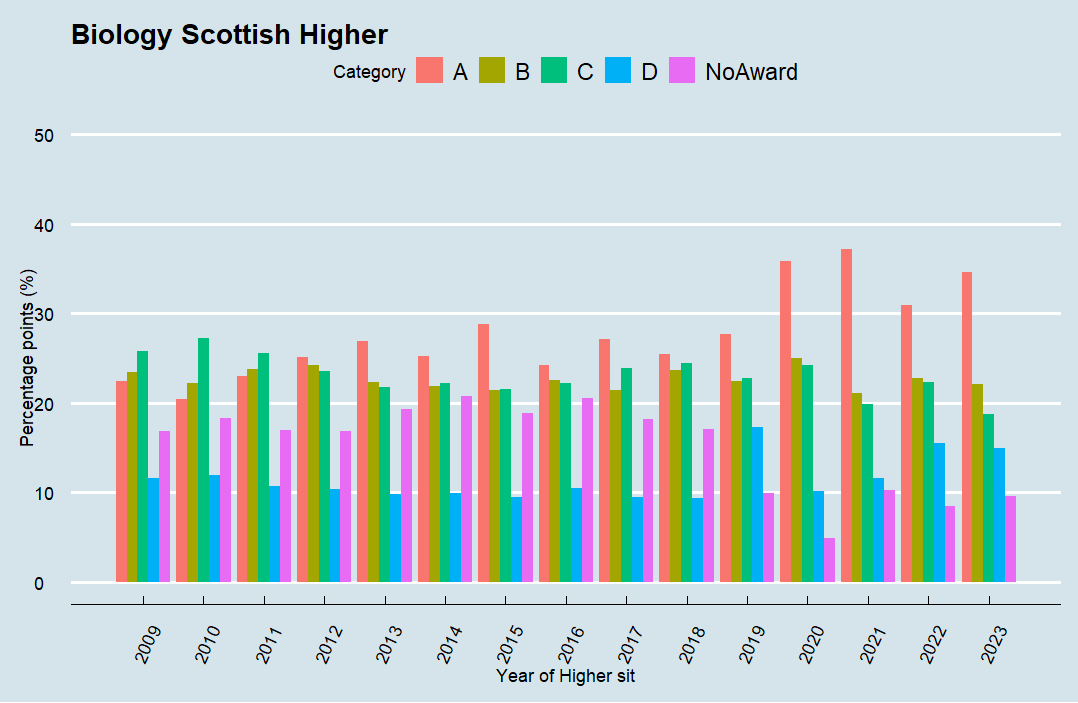
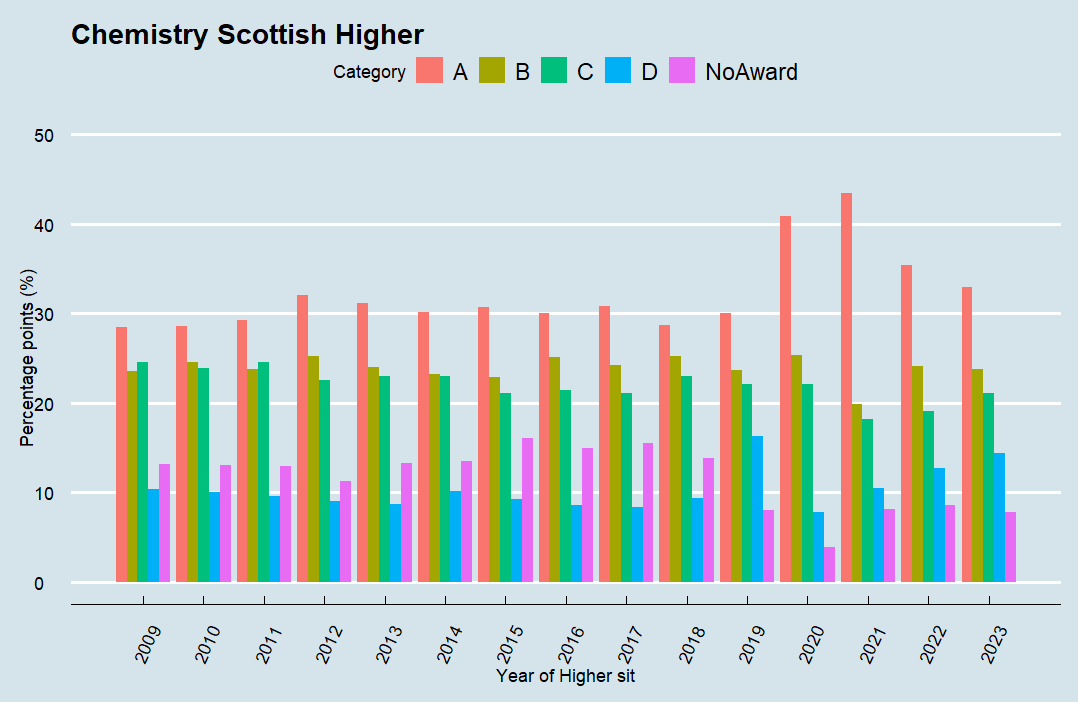
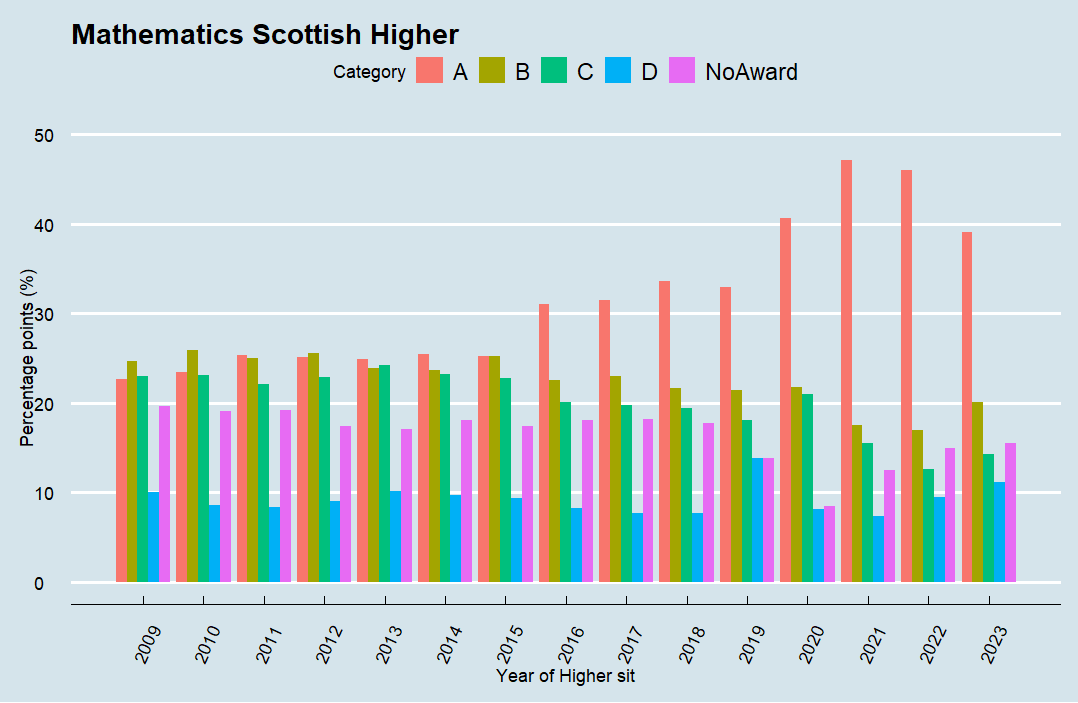
A similar pattern is evident in the four most popular subjects by students entries in 2023
-
Biology (7075):
-
Chemistry (9685):
-
Maths (18705):
-
English (35520):
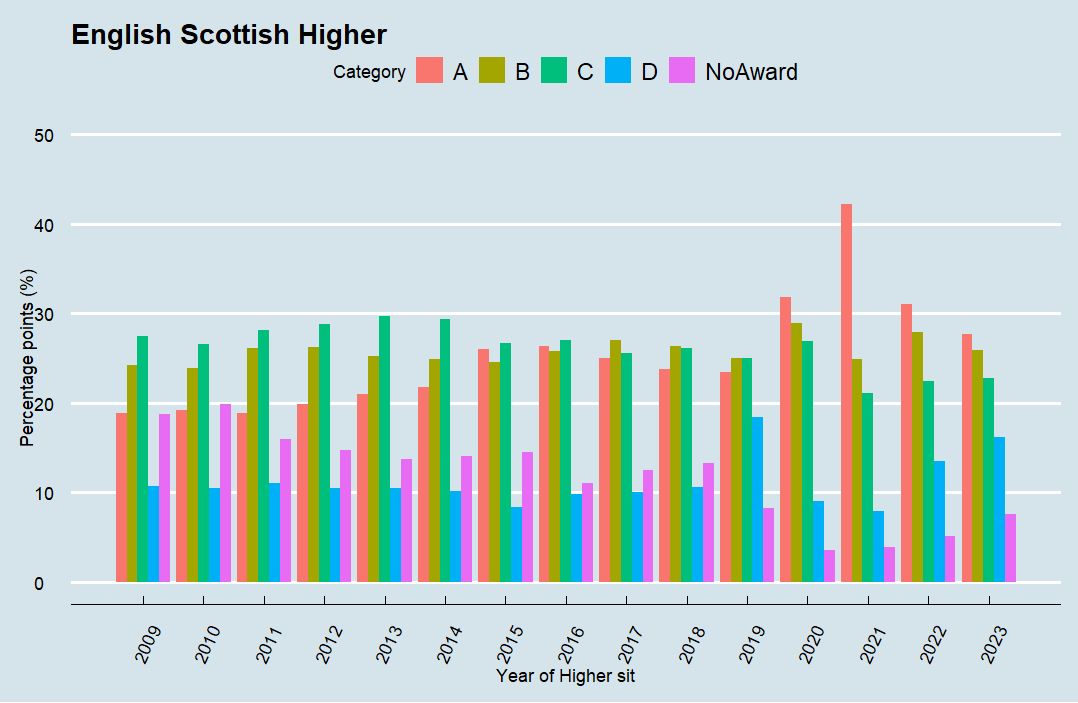
Each subject follows a similar trend general trend: a gradual increase in top grades pre-pandemic, a sharp spike during the pandemic and a subsequent decline – although it is still higher than in pre pandemic levels. The surge in the attainment top grades can be explained by the shift to teacher-assed grading, which often resulted in a more favourable outcome. Another factor may be that improved teaching techniques and better resources have led to improvements. Another factor may be curriculum reform. All this may be a contributing factor, but to state that exams are ‘easier’ is harder to prove than the simple fact that Scottish student are attaining better higher results now than 10 years ago.
The Impact on University Admissions
A key question remains: What impact does this trend have on university admissions? The following table illustrates what 2023 attainment results would have looked like had they followed the same distribution as in 2009:
| Grade / | Expected (from 2009) / | Actual (from 2023) / | Difference (Expected – Actual) |
|---|---|---|---|
| A | 48,010 | 63,820 | -15,810 |
| B | 49,495 | 46,025 | 3,470 |
| C | 47,803 | 38,634 | 9,169 |
| D | 16,632 | 25,320 | -8,688 |
| No Award | 29,877 | 18,019 | 11,858 |
Note: The number of total entries was 191,820. These figures represent subject entries rather than individual students; nearly all students sit Higher English, so the number of unique students is closer to 35,520.
In 2023, one-third of students attained an A, up from one-fourth in 2009—an increase that has resulted in over 15,000 additional top grades being awarded. While this does not necessarily suggest students are less capable, it does mean that an A holds less distinguishing value than it did in 2009. This inflation of top grades has forced universities to become more selective, increasing the likelihood that highly qualified school leavers are turned away from institutions such as Glasgow, Edinburgh, and St. Andrews. In response, universities may place greater emphasis on extracurricular achievements—such as volunteering and personal statements—or introduce standardized assessments similar to the SAT in the United States or entrance exams used by Oxford and Cambridge. Policies aligned with affirmative action may also play a growing role, may it be the aim to be more diverse, preferring male over female candidates as universities are more female than male (GU 42m:58f, Strath 50m:50f – more of an exception that the rule, EdU 38m:62f)* the Scottish government affirmative of to get 20% of higher education entrants to come from the most deprived 20% of the population by 2030.
The sustained rise in top grades within Scottish Highers presents both opportunities and challenges. On the one hand, it may reflect genuine improvements in education, whether through better teaching techniques, enhanced resources, or curriculum reforms. On the other, it raises concerns about grade inflation, particularly its impact on university admissions. If more students achieve top marks, universities must find alternative ways to differentiate applicants—placing greater weight on extracurriculars, personal statements, internal examination or socio-economic background. As Scotland moves toward its goal of widening access to higher education, the long-term implications of this trend remain uncertain. Will grade inflation continue, further reshaping university admissions and employer perceptions? Or will standardization efforts stabilize attainment levels? What is clear is that the value of an A today is not what it was in 2009, and institutions—both academic and professional—must adapt accordingly.
*(According to full time students during the academic year of 2022/23) GU – Glasgow University Strath – Strathclyde university EdU – Edinburgh University Editor note: I can also link where I got the data from it is a excel government sheet
Resources: https://www.gov.scot/publications/fair-access-higher-education-progress-challenges/
I will likely do more reports on the Scottish education system potentially ideas are
- Grade per sex
- subject preferences by sex
- subject popularity and who knows what else, not guaranting I will get to it soon but I am looking at it overtime
Code: https://github.com/HerrNiklasLange/SQA_analyses/tree/main
library(dplyr) #library to make programme run
library(sf)
library(leaflet)
library(htmlwidgets)
library(htmltools)
library(formattable)
library(readxl)
library(ggplot2)
library(ggpubr)
library(plyr)
library(tidyr)
library(rstatix)
library(ggplot2)
library(ggthemes)#economist theme

setwd("C:\\Users\\nikla\\programming_projects\\R\\SQL")# change this to the address of the data
##Loading the data for male, female, assement centre & education authority
#This is 2023 to 2019
{
all_H <- read_excel("data/all.xlsx", sheet = 6, range = "A4:BD57")
all_AH <- read_excel("data/all.xlsx", sheet = 7, range = "A4:BD57")
all_nat5 <- read_excel("data/all.xlsx", sheet = 5, range = "A4:BD57")

male_H <- read_excel("data/male.xlsx", sheet = 6, range = "A4:BD57")
male_AH <- read_excel("data/male.xlsx", sheet = 7, range = "A4:BD57")
male_nat5 <- read_excel("data/male.xlsx", sheet = 5, range = "A4:BD57")

female_H <- read_excel("data/female.xlsx", sheet = 6, range = "A4:BD57")
female_AH <- read_excel("data/female.xlsx", sheet = 7, range = "A4:BD57")
female_nat5 <- read_excel("data/female.xlsx", sheet = 5, range = "A4:BD57")

in_H <- read_excel("data/independent.xlsx", sheet = 6, range = "A4:BD57")
in_AH <- read_excel("data/independent.xlsx", sheet = 7, range = "A4:BD57")
in_nat5 <- read_excel("data/independent.xlsx", sheet = 5, range = "A4:BD57")

ot_H <- read_excel("data/other.xlsx", sheet = 6, range = "A4:BD57")
ot_AH <- read_excel("data/other.xlsx", sheet = 7, range = "A4:BD57")
ot_nat5 <- read_excel("data/other.xlsx", sheet = 5, range = "A4:BD57")

co_H <- read_excel("data/college.xlsx", sheet = 6, range = "A4:BD57")
co_AH <- read_excel("data/college.xlsx", sheet = 7, range = "A4:BD57")
co_nat5 <- read_excel("data/college.xlsx", sheet = 5, range = "A4:BD57")


EA_H <- read_excel("data/education-authority.xlsx", sheet = 6, range = "A4:BD57")
EA_AH <- read_excel("data/education-authority.xlsx", sheet = 7, range = "A4:BD57")
EA_nat5 <- read_excel("data/education-authority.xlsx", sheet = 5, range = "A4:BD57")
}
#reading the data of 2018 to 2014 as the way the table is read is different
#test = read_excel("data/pre_2019/2013Higher.xls", sheet = 7, range = "A10:H86")
#test = test
#test2 = read_excel("data/pre_2019/2012Higher.xls", sheet = 8, range = "A10:H86")


reading_pre_2014 <- function(genderBased, N5_H_AH){
  #National 5 did not exists here
  if(genderBased){

  }
  else{ # This is a prime example how inconcinstent government data can be
    #temp0 <- paste("data/pre_2019/2014", N5_H_AH,".xls", sep = "") # Dont need this here
    temp1 = read_excel(paste("data/pre_2019/2013", N5_H_AH,".xls", sep = ""), sheet = 7, range = "A10:H86")
    temp1 = select(temp1, c(-"...6", -"...7"))
    temp1 = fix_grade_pre_2014(temp1, 2013)
    temp2 = read_excel(paste("data/pre_2019/2012", N5_H_AH,".xls", sep = ""), sheet = 8, range = "A10:H85")#Here it is 8
    temp2 = select(temp2, c(-"...6", -"...7"))
    temp2 = fix_grade_pre_2014(temp2, 2012)
    temp3 = read_excel(paste("data/pre_2019/2011", N5_H_AH,".xls", sep = ""), sheet = 8, range = "A10:H83")
    temp3 = select(temp3, c(-"...6", -"...7"))
    temp3 = fix_grade_pre_2014(temp3, 2011)
    temp4 = read_excel(paste("data/pre_2019/2010", N5_H_AH,".xls", sep = ""), sheet = 8, range = "A8:H85") #Need to change
    temp4 = select(temp4, c(-"...6", -"...7"))
    temp4 = fix_grade_pre_2014(temp4, 2010)
    temp5 = read_excel(paste("data/pre_2019/2009", N5_H_AH,".xls", sep = ""), sheet = 7, range = "A6:H81")#Years  Check for AH inconcinstent
    temp5 = select(temp5, c(-"...6", -"...7"))
    temp5 = fix_grade_pre_2014(temp5, 2009)

  }
  df = quickMerge(temp1, quickMerge(temp2, quickMerge(temp3 ,quickMerge(temp4, temp5))))
  return(df %>% drop_na())
}
quickMerge <- function(temp1, temp2){#either N5, Higher or AH
  return(merge(x = temp1, y = temp2, by = "TITLE", all = TRUE))
}
reading_2018_to_2014_grades <- function(genderBased, N5_H_AH){
  if(genderBased){

  }
  else{
    paste("data/pre_2019/2014", N5_H_AH,".xls", sep = "")
    temp1 = read_excel(paste("data/pre_2019/2014", N5_H_AH,".xls", sep = ""), sheet = 6, range = "A8:F73") %>% drop_na()
    temp1 = fix_grade_2014_2018(temp1, "2014")
    temp2 = read_excel(paste("data/pre_2019/2015", N5_H_AH,".xls", sep = ""), sheet = 6, range = "A8:F71")%>% drop_na()
    temp2 = fix_grade_2014_2018(temp2, "2015")
    temp3 = read_excel(paste("data/pre_2019/2016", N5_H_AH,".xls", sep = ""), sheet = 6, range = "A8:F56")%>% drop_na()
    temp3 = fix_grade_2014_2018(temp3, "2016")
    temp3[47,1] = "Total"
    temp4 = read_excel(paste("data/pre_2019/2017", N5_H_AH,".xls", sep = ""), sheet = 6, range = "A8:F56")%>% drop_na()
    temp4 = fix_grade_2014_2018(temp4, "2017")
    temp4[47,1] = "Total"
    temp5 = read_excel(paste("data/pre_2019/2018", N5_H_AH,".xls", sep = ""), sheet = 6, range = "A8:F56")%>% drop_na()
    temp5 = fix_grade_2014_2018(temp5, "2018")
    temp5[47,1] = "Total"
    }
  df = quickMerge(temp1, quickMerge(temp2, quickMerge(temp3 ,quickMerge(temp4, temp5))))
  return(df)
}
fix_grade_pre_2014 <- function(df, year){
  print(year)
  df <- df %>% drop_na()
  df <- df %>% mutate(across(-"TITLE", as.numeric))
  #code to find the the numbers of student who didn't get an award
  df[paste(year,"No Award")] <- round(df[2] - (df[3] + df[4] + df[5] + df[6]), digits = 0)
  return(df)
}
fix_grade_2014_2018 <- function(df, year){
  #df[3] <- as.numeric(df[3])
  #df[4] <- as.numeric(df[4])
  #df[5] <- as.numeric(df[5])
  #df[6] <- as.numeric(df[6])
  df <- df %>% filter(!if_any(everything(), ~ . == "***" | is.na(.)))
  df <- df %>% mutate(across(-"TITLE", as.numeric))
  temp_df <- df
  for (i in 3:(length(df))){

    print((temp_df[i]), n = 50)
    print((temp_df[2]))

    print("Math")
    #print((temp_df[2]/100), n = 50)
    #print(temp_df[i], n = 50)
    #print(round((temp_df[i]) * (temp_df[2])/100), n = 50)
    df[i] = round((temp_df[i]) * ((temp_df[2]))/100)
    print(df[i])

    }
  #code to find the the numbers of student who didn't get an award
  df[paste(year,"No Award")] <- round(df[2] - (df[3] + df[4] + df[5] + df[6]), digits = 0)
  return(df)
}
fix_grade_post_2019 <- function(df){
  #df <- (all_H)
  #This whole thing might result in some rounding errors as the percentages don't make any sense
  new_df <- df["Subject"]
  entries_df <- select(df,contains(c("Entries","Subject")))
  colnames(entries_df)[colnames(entries_df) == 'Entries 2023'] <- '2023 ENTRIES'
  colnames(entries_df)[colnames(entries_df) == 'Entries 2022'] <- '2022 ENTRIES'
  colnames(entries_df)[colnames(entries_df) == 'Entries 2021'] <- '2021 ENTRIES'
  colnames(entries_df)[colnames(entries_df) == 'Entries 2020'] <- '2020 ENTRIES'
  colnames(entries_df)[colnames(entries_df) == 'Entries 2019'] <- '2019 ENTRIES'
  df <- select(df,contains("count"))
  year = 2023
  df[df=="[z]"] <-"0"
  df[df=="[c]"] <-"0"
  for (i in 1:(25)){

    if(grepl("B",colnames(df[i]), fixed=TRUE)){
      print("B")
      print(paste(year,"B"))
      new_df[paste(year,"B")] = strtoi(df[[i]]) - strtoi(df[[i-1]])
    }
    else if(grepl("C Count",colnames(df[i]), fixed=TRUE)){
      print("C")
      print(paste(year,"C"))
      new_df[paste(year,"C")] = strtoi(df[[i]]) - strtoi(df[[i-1]])
    }
    else if(grepl("D",colnames(df[i]), fixed=TRUE)){
      print("D")
      print(paste(year,"D"))

      new_df[paste(year,"D")] = strtoi(df[[i]]) - strtoi(df[[i-1]])
    }
    else if(grepl("No",colnames(df[i]), fixed=TRUE)){
      print("No Award")
      print(paste(year,"No Award"))
      new_df[paste(year,"No Award")] = df[i]


    }
    else{
      print("A")
      print(paste(year,"A"))
      new_df[paste(year,"A")] = df[i]
    }
    if(i %% 5 == 0){
      year = year - 1
    }
  }
  new_df <- merge(new_df, entries_df, by = "Subject")

return(new_df)
}


df1 <- reading_pre_2014(FALSE, "Higher")#No award been given needs to be sorted out
df2 <- reading_2018_to_2014_grades(FALSE, "Higher")
df3 <- fix_grade_post_2019(all_H)

df_all <- merge(x=df3, y=merge(x=df2, y=df1, by.x="TITLE", by.y="TITLE", all = TRUE)[], by.x="Subject", by.y="TITLE", all = TRUE)[]

df_NA <- na.omit(df_all)

rownames(df_NA) <- 1:nrow(df_NA)

df <- df_NA[1:30, ]


#Biology, Chemistry, English, Mathematics, Total

main4 <- df %>% filter(Subject %in% c( "Total", "Biology", "Chemistry", "English", "Mathematics")) #"Biology", "Chemistry", "English", "Mathematics",
{


  df_percentage <- main4%>%
    mutate(across(-"Subject", as.numeric))
  df_percentage <- df_percentage %>%
    mutate(across(-"Subject", as.numeric)) %>%
    mutate(across(starts_with("2023"), ~ round(. / df_percentage$`2023 ENTRIES` * 100, digits = 3)))%>%
    mutate(across(starts_with("2022"), ~ round(. / df_percentage$`2022 ENTRIES` * 100, digits = 3)))%>%
    mutate(across(starts_with("2021"), ~ round(. / df_percentage$`2021 ENTRIES` * 100, digits = 3)))%>%
    mutate(across(starts_with("2020"), ~ round(. / df_percentage$`2020 ENTRIES` * 100, digits = 3)))%>%
    mutate(across(starts_with("2019"), ~ round(. / df_percentage$`2019 ENTRIES` * 100, digits = 3)))%>%
    mutate(across(starts_with("2018"), ~ round(. / df_percentage$`2018 ENTRIES` * 100, digits = 3)))%>%
    mutate(across(starts_with("2017"), ~ round(. / df_percentage$`2017 ENTRIES` * 100, digits = 3)))%>%
    mutate(across(starts_with("2016"), ~ round(. / df_percentage$`2016 ENTRIES` * 100, digits = 3)))%>%
    mutate(across(starts_with("2015"), ~ round(. / df_percentage$`2015 ENTRIES` * 100, digits = 3)))%>%
    mutate(across(starts_with("2014"), ~ round(. / df_percentage$`2014 ENTRIES` * 100, digits = 3)))%>%
    mutate(across(starts_with("2013"), ~ round(. / df_percentage$`2013 ENTRIES` * 100, digits = 3)))%>%
    mutate(across(starts_with("2012"), ~ round(. / df_percentage$`2012 ENTRIES` * 100, digits = 3)))%>%
    mutate(across(starts_with("2011"), ~ round(. / df_percentage$`2011 ENTRIES` * 100, digits = 3)))%>%
    mutate(across(starts_with("2010"), ~ round(. / df_percentage$`2010 ENTRIES` * 100, digits = 3)))%>%
    mutate(across(starts_with("2009"), ~ round(. / df_percentage$`2009 ENTRIES` * 100, digits = 3)))

  df_percentage <- df_percentage %>% select(-contains('ENTRIES'))
  colnames(df_percentage) <- gsub(" ", "", colnames(df_percentage))
  df_percentage[] <- lapply(df_percentage, function(x) if(is.character(x)) x else as.character(x))


  df_graph2 <- df_percentage %>%
    pivot_longer(
      cols = -Subject,
      names_to = c("Year", "Grade"),
      names_sep = "(?<=\\d)(?=[A-Z])",  # Regular expression to separate year and grade
      values_to = "Value"
    )

  # Convert Year to numeric
  df_graph2$Year <- as.numeric(df_graph2$Year)
  df_graph2$Value <- as.numeric(df_graph2$Value)


  {
  ggplot(df_graph2 %>%
           filter(Subject == "Biology"), aes(x = Year, y = Value, fill = Grade)) +
    geom_bar(stat = "identity", position = "dodge") +
    labs(
      #title = "All Scottish Higher results",
      title = "Biology Scottish Higher",
      x = "Year of Higher sit",
      y = "Percentage points (%)",
      fill = "Category"
    ) +
    scale_y_continuous(limits=c(0, 50)) +
    theme_economist() +
    scale_x_continuous(breaks = unique(df_graph2$Year)) +
    theme(axis.text.x = element_text(angle = 65, hjust = 0))
  }#Biology
  {
    ggplot(df_graph2 %>%
             filter(Subject == "Chemistry"), aes(x = Year, y = Value, fill = Grade)) +
      geom_bar(stat = "identity", position = "dodge") +
      labs(
        #title = "All Scottish Higher results",
        title = "Chemistry Scottish Higher",
        x = "Year of Higher sit",
        y = "Percentage points (%)",
        fill = "Category"
      ) +
      scale_y_continuous(limits=c(0, 50)) +
      theme_economist() +
      scale_x_continuous(breaks = unique(df_graph2$Year)) +
      theme(axis.text.x = element_text(angle = 65, hjust = 0))
  }#Chemistry
  {
    ggplot(df_graph2 %>%
             filter(Subject == "English"), aes(x = Year, y = Value, fill = Grade)) +
      geom_bar(stat = "identity", position = "dodge") +
      labs(
        #title = "All Scottish Higher results",
        title = "English Scottish Higher",
        x = "Year of Higher sit",
        y = "Percentage points (%)",
        fill = "Category"
      ) +
      scale_y_continuous(limits=c(0, 50)) +
      theme_economist() +
      scale_x_continuous(breaks = unique(df_graph2$Year)) +
      theme(axis.text.x = element_text(angle = 65, hjust = 0))
  }#English
  {
    ggplot(df_graph2 %>%
             filter(Subject == "Mathematics"), aes(x = Year, y = Value, fill = Grade)) +
      geom_bar(stat = "identity", position = "dodge") +
      labs(
        #title = "All Scottish Higher results",
        title = "Mathematics Scottish Higher",
        x = "Year of Higher sit",
        y = "Percentage points (%)",
        fill = "Category"
      ) +
      scale_y_continuous(limits=c(0, 50)) +
      theme_economist() +
      scale_x_continuous(breaks = unique(df_graph2$Year)) +
      theme(axis.text.x = element_text(angle = 65, hjust = 0))
  }#Mathematics
}